






 Share Story


BAGHDAD — Multiple ground assaults and a deluge of air strikes shrank the Daesh terror group’s “caliphate” to a rump and decimated its fighters in 2016 but the organisation remains a potent threat.
The extremists have squandered close to half of the land they controlled in 2014 and many of their losses came this year, which saw major operations by myriad forces and countries.
The loss of symbolic bastions such as Fallujah in Iraq or Dabiq in Syria dented Daesh’s aura, revealing it could not defend places it once vowed were impregnable and central to its own mythology.
The extremists were driven out of Ramadi, the capital of Iraq’s vast western province of Anbar, as well as Manbij in Syria — strategic areas crucial to the caliphate’s territorial continuity.
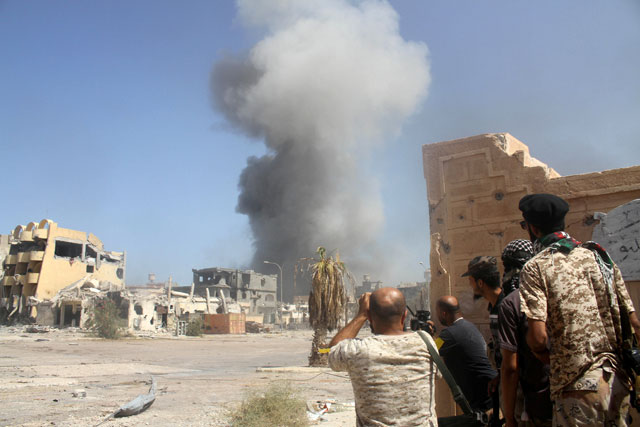
Earlier this month, they also lost Sirte, their last major bastion in Libya, a country the extremists had hoped could drive the expansion of the “caliphate”.
In October, tens of thousands of Iraqi forces backed by air strikes from a US-led coalition launched a massive operation to retake Mosul, the city where Daesh supremo Abu Bakr Al Baghdadi proclaimed his “state” in June 2014.
The going has been tough for the security forces in the booby-trapped and sniper-infested streets of Iraq’s second city but there is little doubt the vastly outnumbered extremists will eventually lose their stronghold.
Operations for a similar assault on Raqqa, the only other major urban centre in Daesh hands, were subsequently launched in Syria, setting up a battle that could be the “caliphate’s” last stand.
“The loss of Raqqa will mean the end of Daesh’s state-building project and would leave the group with no territorial symbol justifying its name of Islamic State,” said Mathieu Guidere, a Paris-based professor of Middle East geopolitics.
Western powers, Turkey, Iran, Iraqi and Syrian Kurdish forces and militias and paramilitary outfits have played a part in the surge against Daesh in 2016.
Terror attacks
Despite the formidable arsenal Daesh seized from regular forces and the fear it instilled in the world with its campaign of well-publicised atrocities, the extremist group stopped expanding and eventually buckled.
According to the Pentagon, at least 50,000 Daesh militants have been killed since 2014, twice the number of extremists the coalition estimated the group had when the “caliphate” was proclaimed.
“Almost 3 million people and more than 44,000 square kilometres of territory have been liberated” from Daesh in 2016, coalition commander Lieutenant General Steve Townsend said Wednesday.
But coordination between the various, sometimes rival anti-Daesh forces is still lacking, and the extremists have shown in two months of Mosul fighting they would not be defeated easily.
Their urban tactics are well honed and their seemingly endless supply of suicide bombers is a threat even the best-trained and equipped forces on the ground fear like no other.
Daesh has also launched a number of diversionary attacks in both Iraq and Syria in an effort to stretch their opponents’ ranks and retain some level of initiative, at least in the media.
Those came in the shape of a spectacular commando raid on Iraq’s oil-rich and Kurdish-controlled city of Kirkuk, and earlier this month with the recapture of the Syrian oasis city of Palmyra from regime forces.
Observers have long warned that territorial reconquest would not spell the end of the Daesh group, which will find in both Iraq’s and Syria’s instability a fertile ground for future attacks.
“2016 was the year of Daesh’s decline but its influence is still great because there is no political solution in sight... especially for the Sunni population in both countries,” Guidere said.
The remnants of Daesh could in some ways be harder to fight once they have fully reverted to a clandestine insurgent group focused on terror attacks.
The feared mass return of the “caliphate’s” routed foreign militants is also a huge source of concern at the end of a year that saw attacks claimed or inspired by Daesh in the United States, France and Belgium.
“The group has been laying the groundwork to outlast its territorial defeats, framing such losses as temporary setbacks in Iraq and Syria and arguing that Daesh is a state of mind as much as it is a governing state,” the Soufan Group consultancy said earlier this month.
