


Taliban suicide bomber kills 26 in NW Pakistan — officials

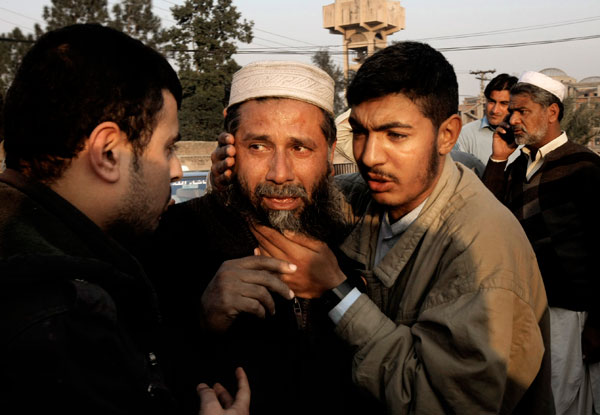
People comfort a man who lost a family member in a suicide attack in Mardan, Pakistan, onTuesday (AP photo)

PESHAWAR/LAHORE — A Taliban suicide bomber on a motorcycle killed 26 people and wounded dozens Tuesday after crashing into the main gate of a government office in northwest Pakistan, officials said.

The blast in the town of Mardan demonstrated the Pakistani Taliban's continued ability to stage deadly attacks, despite a major military offensive against its headquarters that analysts say has reduced its capacity.

The explosion ripped through the front entrance of a regional branch of the National Database and Registration Authority, which is responsible for issuing ID cards.

"At least 26 people have been killed and more than 50 injured," Provincial Information Minister Mushtaq Ghani told AFP.

"[The] condition of 11 of them is still critical," Ghani added.

District Police Chief Faisal Shahzad said the suicide bomber was riding a motorbike.

"Apparently the target was the queue as there were around 400 people standing there," Faisal told AFP.

Some of those critically wounded were taken to the main Lady Reading Hospital in Peshawar city.

Television footage showed the collapsed front wall of the building and twisted metal debris strewn on the road in the town in Khyber Pakhtunkhwa province.

Eyewitness Nasir Khan, a 29-year-old labourer who suffered a shrapnel injury to his right leg, told AFP: "I was standing in the queue waiting for my turn as I had gone to renew my identity card when I heard someone shouting Allahu Akbar (God is great) and then I fell to the ground.

"The air was filled with smoke and dust and I could not see anything.

"When the dust settled and I stood up, it looked as though someone had butchered the people in the line. There was only blood and flesh in the row where people were previously standing."

Ehsanullah Ehsan, spokesman for the hardline Jamaat-ul-Ahrar faction of the Tehreek-e-Taliban Pakistan (Pakistani Taliban), claimed responsibility. 

"This office was attacked because it is an important institution of the infidel state of Pakistan," he said in an e-mail, vowing further attacks.


Crackdown on militancy 


Pakistan has been battling an insurgency since 2004 after the US-led invasion of Afghanistan caused fighters to flee across the border, where they began to foment unrest.

More than 27,000 civilians and security personnel have died in attacks since that time, according to the South Asia Terrorism Portal, a monitoring site.

But overall levels of extremist-linked violence have dropped dramatically this year, with 2015 on course for the fewest deaths since 2007 — the year the Pakistani Taliban umbrella group was formed.

Analysts have credited the fall to military operations against the Taliban in the tribal areas of North Waziristan and Khyber where they are headquartered, as well as in the country's largest city of Karachi.

Meanwhile, Pakistani police have arrested eight suspected members of the Daesh terro group for planning to establish a terrorist network and carry out attacks, officials said Tuesday.

The eight suspects were arrested after anti-terror police raided their hideout in Daska, central Punjab, provincial Law Minister Rana Sanaullah told AFP. 

“They were trying to establish their group network and had plans to carry out attacks,” said Sanaullah.

“All of them are young and in their 20’s,” Sanaullah added. “They were taking instruction via the Internet from a person named Abu Muawiyah.”

He said that police also recovered “Daesh literature and CDs”. 

Police commandos from the counter-terrorism department (CTD) raided the hideout and made the arrests on Monday, according to the official.


A senior CTD official confirmed the arrests and told AFP that some of the suspected militants were former members of Jamaat-ud-Dawa, a charity associated with the Pakistani militant group Lashkar-e-Taiba.

.col-lg-12.second .opinion-widget{border-top:1px solid #D0D0D0;} #widget_1623 .opinions-title {font-size:32px;} #widget_1623 .opinions-title a{font-size:32px;} .first-author{ background-color:#ecedef; } .first-opinion-author-name{ background-color:white; width:max-content; padding:5px; }
.epaper-separator{ height: 1px; width: 100%; background-color: #D0D0D0; margin: 15px 0; }

Today’s Paper

.related-articles .article-widget-sm .article-title{font-size:16px;-webkit-line-clamp:3;} .related-articles .layout-ratio{padding-bottom:55%;}
.alert-success { color :#A3656F ; } .alert-danger { color : red ; } .footer { font-family:Myriad Pro,Arial; } .newspaper-footer{ visibility:hidden; } .socialFixOuter { position: fixed; top: 50%; margin-top: 40px; right: 0; transition: .2s; z-index: 20; height: 217px; width: 40px; } .socialFix { height: 30px; width: 30px; display: block; position: relative; cursor: pointer; background-size: 18px 18px; transition: .2s; background-position: center; background-repeat: no-repeat; border-radius: 2px; margin-top: 1px; } .socialFix:hover { width: 40px; margin-left: -10px; } .app-badge-img { height: 36px; width: auto; } @media (max-width: 768px) { .app-badge-img { height: 32px; } .app-badges { justify-content: center !important; } }
document.addEventListener("DOMContentLoaded", function () { const socialFix = document.querySelector(".socialFixOuter"); if (!socialFix) return; let firstInteraction = false; let hideTimeout = null; function checkMobileScreen() { if (window.innerWidth < 768) { socialFix.style.display = "none"; } else { socialFix.style.display = "block"; } } checkMobileScreen(); window.addEventListener("resize", checkMobileScreen); function handleFirstInteraction() { if (firstInteraction) return; if (window.innerWidth < 768) return; firstInteraction = true; socialFix.style.right = "-25px"; } socialFix.addEventListener("mouseenter", function () { if (window.innerWidth < 768) return; if (hideTimeout) clearTimeout(hideTimeout); socialFix.style.right = "0"; }); socialFix.addEventListener("mouseleave", function () { if (window.innerWidth < 768) return; if (hideTimeout) clearTimeout(hideTimeout); hideTimeout = setTimeout(() => { socialFix.style.right = "-25px"; }, 500); }); ["click", "touchstart"].forEach((evt) => { socialFix.addEventListener(evt, handleFirstInteraction); }); }); function validateEmail(email) { if (email.length > 255) return false; const emailRegex = /^[a-zA-Z0-9._%+-]+@[a-zA-Z0-9.-]+\.[a-zA-Z]{2,}$/; if (!emailRegex.test(email)) return false; if (email.includes('..') || email.startsWith('.') || email.endsWith('.')) return false; return true; } function sanitizeInput(input) { input = input.replace(/<[^>]*>/g, ''); input = input.replace(/javascript:/gi, ''); input = input.replace(/on\w+\s*=/gi, ''); input = input.replace(/[<>"'&(){}[\]]/g, ''); return input.trim(); } document.addEventListener('DOMContentLoaded', function () { function showModal(message, type) { const messageContainer = document.getElementById("messageContainerFooter"); messageContainer.textContent = message; messageContainer.className = `alert alert-${type} mt-3`; messageContainer.classList.remove("d-none"); setTimeout(() => { messageContainer.classList.add("d-none"); }, 5000); } document.getElementById("emailFormFooter").addEventListener("submit", function(event) { event.preventDefault(); const emailInput = document.getElementById("emailFooter"); const email = sanitizeInput(emailInput.value.trim()); if (!validateEmail(email)) { showModal('Invalid email format', 'danger'); return; } const formData = new FormData(); formData.append('email', email); fetch('/subscribeNewsletter', { method: "POST", body: formData, headers: { "Accept": "application/json", "X-Requested-With": "XMLHttpRequest" } }) .then(response => { if (!response.ok) { showModal("Error submitting email. Try again.", 'danger'); } return response.json(); }) .then(data => { showModal(data.message, 'success'); }) .catch(error => { showModal("Error submitting email. Try again.", 'danger'); }); }); });