






 Share
Share


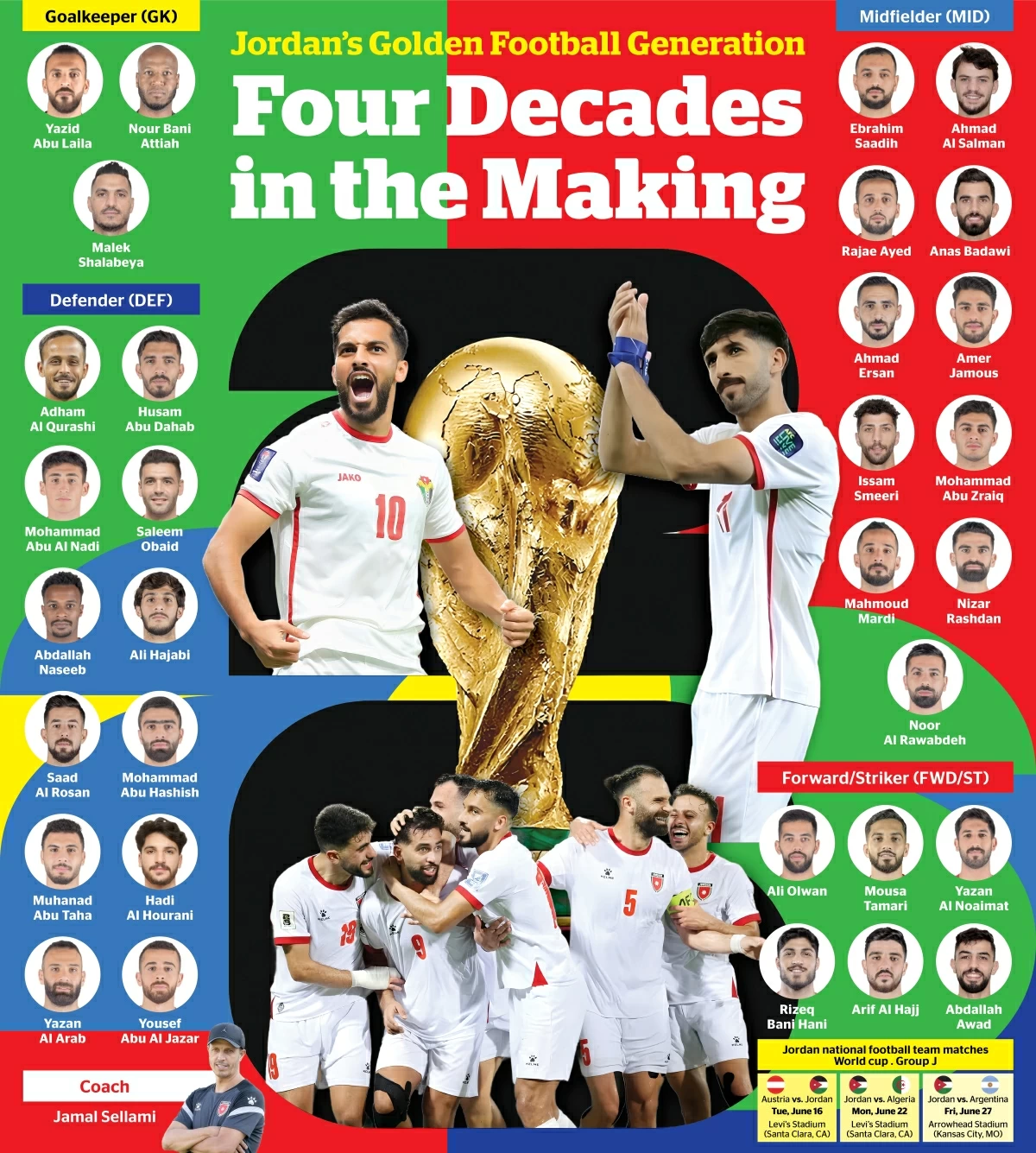
For forty years, since Jordan’s national football team played their first World Cup qualifying match in March 1985, the Hashemite Kingdom has been striving to reach football’s most prestigious tournament. Today, that dream has finally become reality.
In previous campaigns, Jordan came tantalisingly close to breaking through—particularly during the 2014 World Cup qualifiers—whilst on other occasions they fell at early hurdles. This time, however, they have succeeded, earning their place in the 23rd edition of the tournament scheduled for the United States, Mexico and Canada in the summer of 2026.
For this World Cup, FIFA has expanded the field from 32 teams in previous editions to 48, with each continent allocated additional places. Asia’s allocation has increased from four spots to 8.5 places for the upcoming tournament, with 46 nations competing in qualifying rounds that began in late 2023 and conclude in November 2025.
The qualifying process was divided into four rounds. In the first round, the 20 lowest-ranked Asian teams on FIFA’s lists competed, with ten progressing to the second round. The second round featured 36 teams—the top 26 ranked nations plus the ten qualifiers from round one—divided into nine groups of four, with the top two from each group advancing to round three.
Jordan began their qualifying campaign from the second round, playing six matches in Group Seven alongside Saudi Arabia, Tajikistan and Pakistan. Playing each team twice, Jordan topped their group after winning four matches, drawing one and losing one. Despite finishing level on points with Saudi Arabia, Jordan progressed on goal difference, with both teams advancing to the third round.
In round three, Jordan found themselves in a challenging group containing South Korea, Iraq, Oman, Palestine and Kuwait. The top two teams from each group qualify directly for the World Cup, whilst the third-placed side advances to round four for inter-confederation play-offs.
During these qualifiers, Jordan’s national team defeated strong Asian sides on their own turf, including Saudi Arabia—a nation with six previous World Cup appearances. They also overcame teams ranked higher than them in FIFA’s rankings, such as Iraq, who occupied 63rd position when qualifying began in 2023, compared to Jordan’s 87th place. Jordan also held their own against formidable opponents like South Korea, Asia’s most frequent World Cup participants and the continent’s best-ever performers, having reached the semi-finals on home soil in 2002. They also drew with teams who historically dominated head-to-head records, such as Kuwait, who had previously won 13 of 33 meetings between the sides, with 13 draws and just seven Jordanian victories.
Jordan’s qualifying success represents the culmination of a remarkable transformation in Jordanian football over recent years. The national team achieved their best-ever result by reaching the final of the 2024 Asian Cup, whilst youth teams secured their first international titles—the under-23s winning the West Asian Championship in 2021, and the under-16s claiming the West Asian title in 2022/2023.
The professionalisation of Jordanian players has proved crucial to this development. The number of Jordanian professionals playing abroad has risen dramatically from approximately 30 in the 2021-22 season—then a national record—to around 62 by 2023.
Of the 22 players called up for the national team during the early qualifying rounds, 17 were professionals or had previously played professionally outside Jordan in countries including France, Malaysia, Saudi Arabia, Qatar, South Korea and others. Against Oman, Jordan’s entire starting eleven comprised professionals or former professionals playing abroad, with just one exception.
The impact of this overseas experience is evident in the statistics. Jordan’s attacking trio—all professionals abroad—Mousa Al-Tamari, Ali Alwan and Yazan Al-Naimat scored 12 of Jordan’s 16 goals in round two, and 13 of 16 in round three.
Former Jordan striker and current Al-Buqa’a coach Mahmoud Shelbaya believes the impact of professionalisation has been decisive in two ways. Playing abroad has provided Jordanian players with exposure to foreign players and coaches, improving their discipline, tactical understanding and adherence to instructions. Additionally, professionalism has transformed players’ mentality regarding lifestyle and nutrition appropriate for elite athletes.
Shelbaya also notes that domestic league players view international matches as opportunities to secure professional contracts abroad or increase their transfer value, motivating peak performance. “When you qualify for the World Cup, or win the Asian Cup, people will notice you more than if your team goes out in the second round or round of 16,” he explains.
Beyond professionalisation, Jordan benefitted from the declining form of some regional rivals during qualifying. Several traditionally strong teams have struggled recently, as reflected in FIFA rankings. Iraq, who shared Jordan’s group, suffered the world’s largest ranking point decline (29.46 points), whilst South Korea dropped 10.52 points.
This decline helped Jordan secure valuable points against these teams whilst their opponents dropped points elsewhere—South Korea notably losing ground against Oman and Palestine.
When comparing the relative impact of Jordan’s improvement versus their rivals’ decline, coach Salah Al-Jallad believes Jordan’s development was the decisive factor, though he expresses concern about maintaining this trajectory.
Multiple former players and coaches describe this Jordan generation as superior to any previous incarnation. Al-Jallad, who began coaching in 2007, attributes this generation’s quality to groundwork laid years earlier through the Prince Ali Centres for Promising Players, established in 2001 with 35 branches across the kingdom, focusing on discovering and training players aged 8-12.
For years, these centres supplied Jordan’s national teams with high-calibre players who made significant impacts—from the 2007-born generation who reached the World Cup in Canada, to the under-16s who won the West Asian Championship in 2022/2023, and now the senior team qualifying for their first World Cup.
The current squad includes at least seven players who trained at these centres: Yazan Al-Naimat, Mousa Al-Tamari, Ehsan Haddad, Abdullah Naseeb, Nizar Al-Rashdan, Ibrahim Sabra and Ibrahim Saada.
The Jordan Football Association closed these centres in 2019. Al-Jallad subsequently moved from the centres to coaching national youth teams (under-16, under-17, under-19), where he has observed declining standards compared to the Prince Ali Centres era. “Unfortunately, neither the quality of players, nor the raw materials, nor the talent [are the same],” he notes.
Al-Jallad explains that the centres nurtured players from a young age, meaning by age 20 they possessed approximately 12 years of training experience. Since the centres’ closure, players’ training age has dropped to 4-6 years, as clubs lack the financial capacity to establish and train youth teams below 14 or 16 years old.
Al-Jallad fears the impact of closing the Prince Ali Centres on the national team’s future performance: “The concern is that in four or five years, there won’t be a generation like this one, which is the product of His Highness Prince Ali’s centres.” Meanwhile, Shelbaya advocates for a comprehensive age-group strategy independent of World Cup qualification to develop players of similar quality to the current generation.
After four decades of attempting to reach football’s most important tournament, Jordan’s national team has finally arrived through a confluence of factors that combined to achieve unprecedented success. Led by a generation trained from an early age and featuring numerous professionals in advanced leagues, this represents the golden generation of Jordanian football.
