






 Share Story


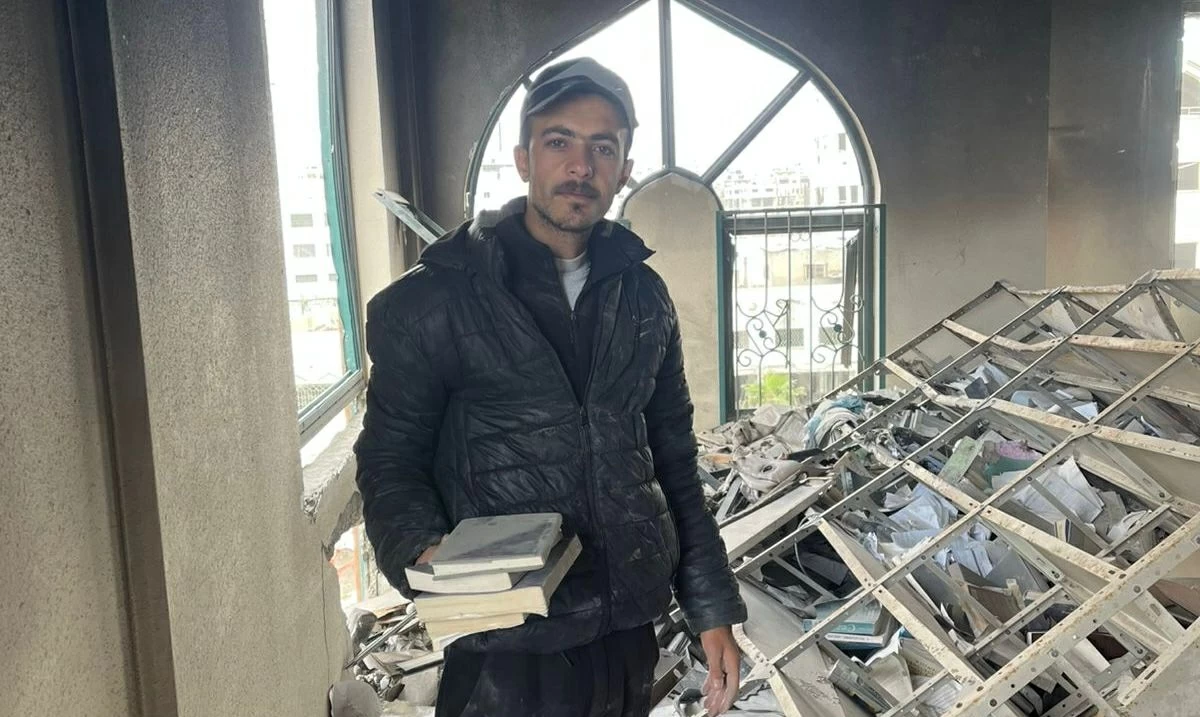
AMMAN – When the Israeli bombs began to destroy Gaza, Omar made a decision that would define the next two years of his life: he would not leave his books behind.
Through bombardment, displacement, famine, and the destruction of nearly every cultural space around him, he kept his personal library close, carrying it from place to place as he and his family fled repeated attacks.
Omar was uprooted 12 times, yet the books remained with him every step of the way. Only after recounting the scale of the displacements does Omar explain what it meant to hold onto these books:
“To begin, with my own personal library that I carried with me from the first day of the genocide until this very moment — I was displaced 12 times with it.
Perhaps it sounds easy to say, ‘I was displaced 12 times,’ but the bitterness of displacement is harsher than the bitterness of loss, and I have lived through both,” Omar told The Jordan Times.
Omar is now attempting to rebuild what he describes as the first new library in Gaza after the destruction of universities, cultural centres, and independent libraries across the Strip.
His effort emerges from months spent rescuing books from bombed institutions, abandoned homes and damaged shelves — often while people around him used the same books as fuel for cooking fires.
Edward Said Library
The first major rescue effort Omar participated in involved the Edward Said Library in Beit Lahia. “Edward Said Library in Beit Lahia was the first library we rescued. It belonged to its owner, the writer Musab Abu Toha, but he left Gaza at the start of the genocide, and his home and library were destroyed.”
When Omar, along with two friends, returned to northern Gaza from the south, they found remnants of the library still standing.
“When we returned from southern Gaza to the north, my friend Ibrahim, my friend Hossam, and I went to the library and retrieved whatever books remained.”
Books used for cooking amid famine
What he witnessed next at the Islamic University of Gaza marked another turning point.
“At the university’s library, people had begun taking books to use for cooking. My brothers and I went there and rescued many books — some over 100 years old. I collected them in bags and carried them on a donkey cart.”
The destruction of cultural spaces is not abstract to him. Books formed the structure of his daily life, even under the most extreme conditions.
“Books are not sacred objects or beautiful ornaments to me; they are an inseparable part of my soul. They are my daily ritual. They shaped my personality, my thoughts, and even my imagination. Not a single day during the genocide passed without me reading.”
Community focused on survival
Omar explains that in the midst of bombardment and famine, people were focused on survival. “The community was occupied with something far more urgent than books: survival.”
During one of the worst phases of hunger, he faced an ethical dilemma.
“Famine and suffering did not allow our community to care about books. Even during the harshest phase of the famine, I offered that library for sale in exchange for a bag of flour.”
“At that time, I was fully aware that a loaf of bread in the mouths of my mother, father, siblings, and my nephew was more important than a million books.”
He recalls witnessing people burning books to cook meals.
“I used to pick up the books from there to save them, while people were taking them to light fires for cooking. I didn’t have the ability to tell them that these books were valuable; my words would have been meaningless compared to the suffering they were going through, with no gas or firewood.
It was the moment I felt most powerless.”
Impact of cultural loss
“The loss of libraries, schools, and cultural landmarks affected me deeply, as I felt that a part of my soul and knowledge was being erased,” he explained.
“My family suffered from the loss of educational opportunities, especially for the children. As for the community, everyone felt a cultural void, and many drifted away from reading and learning. It was very difficult to preserve the cultural spirit amidst this destruction.”
“What can you expect from a community that has been deprived of education and reading for a full two years — not by choice, but forced by killing, destruction, bombing, and blood?”
Despite the overwhelming challenges, Omar managed to save a broad range of titles.
“There are many types of books that I rescued. Most of them are novels from Russian literature, as well as educational textbooks in subjects like physics and chemistry.”
“There are also Islamic books from the four imams: Ahmad ibn Hanbal, Anas ibn Malik, Al Shafi’i, and Al Hanafi. Additionally, there are fictional novels such as Harry Potter, The Lord of the Rings, and many others.”
His goal is to preserve this collection while expanding it. “I plan to use these books, and I also want to print many more books, including children’s books. There will also be a special section for visual arts, featuring works by Gazan artists who painted during the genocide.”
As Gaza continues to face severe destruction of schools, universities, archives and cultural institutions, Omar’s initiative stands out as a grassroots attempt to protect what remains of the Strip’s intellectual and cultural life. His objective is straightforward: to preserve books now so that, one day, people can return to them.
He continues to rebuild, book by book, in a place where almost everything else has been lost.
