






 Share Story


WADI RUM — As regional instability continues to shape travel patterns across the Middle East, a quieter shift is taking place within Jordan’s tourism sector.
Wellness tourism, long associated with international visitors seeking treatment and relaxation, is increasingly drawing local and regional travellers, offering both economic resilience and new forms of engagement with the country’s landscapes.
Wellness tourism in Jordan has gradually evolved into a key pillar of the country’s broader tourism strategy, positioned at the intersection of natural healing resources and a well-developed medical sector. The country has long marketed itself as a regional hub for both medical and wellness tourism, a distinction reinforced by international organizations such as the UN World Tourism Organization.
For Aya Qadi, owner of Wellness by Antara, this transformation has been both strategic and necessary.
“Unlike conventional tourism, it is less dependent on seasonality and more driven by demand for meaningful, restorative experiences,” she told The Jordan Times. “We started with stargazing which was very well received by the community, and when the international tourism completely stopped because of the situation in the region, we had the opportunity to pause the project or pivoting to a local market, which is where wellness came in. We had big demands from Amman and Aqaba.”
Her experience reflects a broader trend. As international travel fluctuated, local demand began to fill the gap.
“Wellness tourism is one of the fastest growing tourism sector and is one of the most resilient,” Qadi noted. “Also with the uncertainty in the region, people need an escape, there is a need for connexion, restoration, and in the city it is not very possible.”
At the heart of Jordan’s wellness appeal lies its geography. From the mineral-rich waters of the Dead Sea to the desert landscapes of Wadi Rum and the coastline of Aqaba, the country offers a compact yet diverse range of environments that can be experienced within hours.
“Our serving point for wellness tourism in Jordan is the landscape,” Qadi said. “We try to do wellness shaped by landscape.”
This approach, she explained, goes beyond scenery. “We always include the local community, because the landscape might be beautiful but it is never complete without them. What is a place without its people? For the stargazing, our team is 100 per cent local community and all the products we use are locally sourced.”
Such initiatives are helping redistribute tourism benefits more evenly, particularly in areas outside traditional urban centres. Wellness experiences — from guided stargazing sessions to retreats and outdoor practices — often rely on local expertise, materials and knowledge, creating new opportunities at the community level.
The sector is also evolving in response to changing traveller preferences. “International visitors,” Qadi said, “are increasingly drawn to Jordan’s dark skies, a resource that must be protected. At the same time, local demand is shaping new trends.”
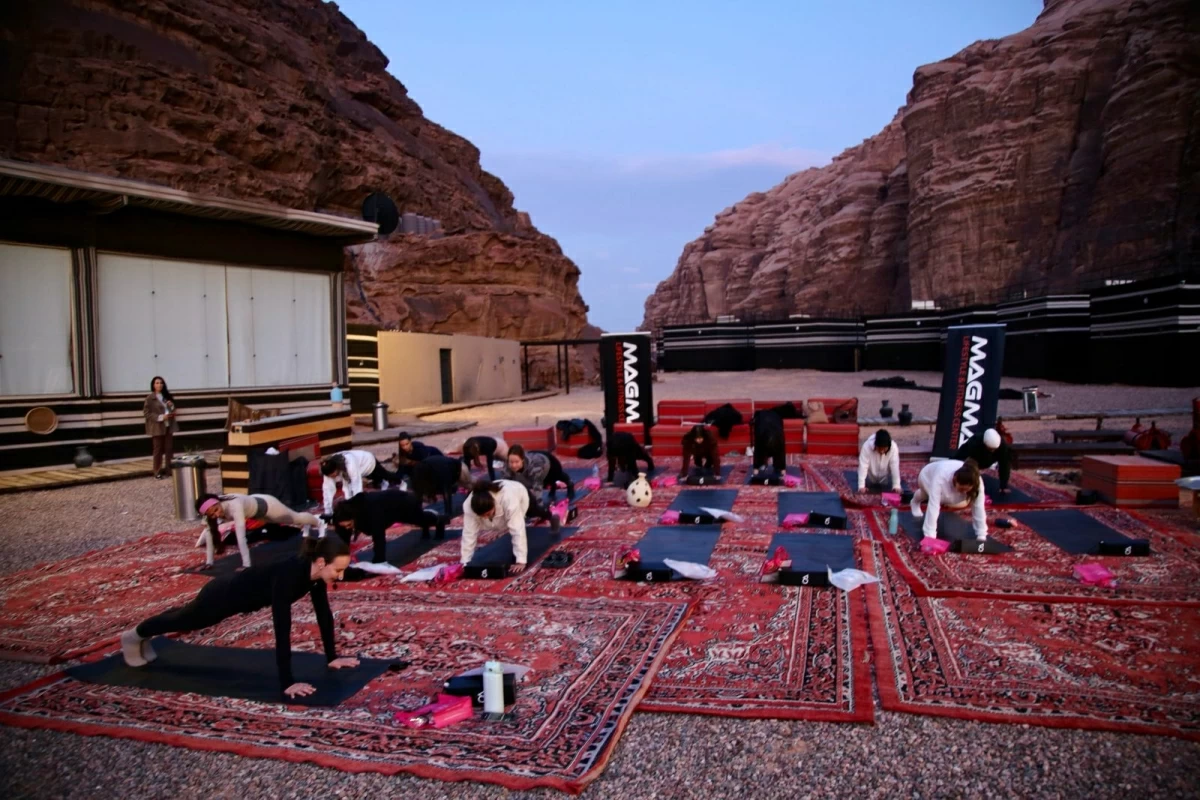
“Pilates is a huge trend, people want to do Pilates in beautiful areas and we provide that for them,” she said, adding that activities such as “moon bathing” and “moon gazing” are also gaining popularity.
This diversification reflects a broader redefinition of wellness tourism, one that extends beyond spa treatments to include immersive, landscape-based experiences. Qadi describes it as a holistic approach built around “sands, stones, sea and sky,” with each destination offering a distinct dimension of well-being. Meditative sessions in Wadi Rum draw on its vast night skies, while the Dead Sea’s mineral composition supports therapeutic treatments, and Aqaba provides a coastal setting for movement-based practices.
Central to this model is the concept of the “Golden Triangle”, linking Wadi Rum, the Dead Sea and Aqaba, which Qadi describes as “one of the best naturally aligned wellness circuits in the world,” particularly suited to travellers with limited time.
Jordan’s experience reflects a wider global trend, with wellness tourism recognized as one of the fastest-growing segments in the industry. Yet the country’s advantage lies in its ability to anchor this growth in its natural and cultural landscapes, rather than relying solely on built infrastructure.
“We are quite lucky,” Qadi said. “Wellness is very natural in Jordan, we’re just using the landscape, it’s already here. We’re just helping design a platform to enable access.”
As the sector continues to expand, this model, grounded in place, community and adaptability, may prove central not only to attracting international visitors, but also to sustaining tourism from within.
