






 Share Story


AMMAN — The Vocational Training Corporation (VTC) has begun adopting a partnership-based approach with the private sector to deliver training programmes aimed at equipping young Jordanians with the skills needed to meet actual labour market demands across various sectors.
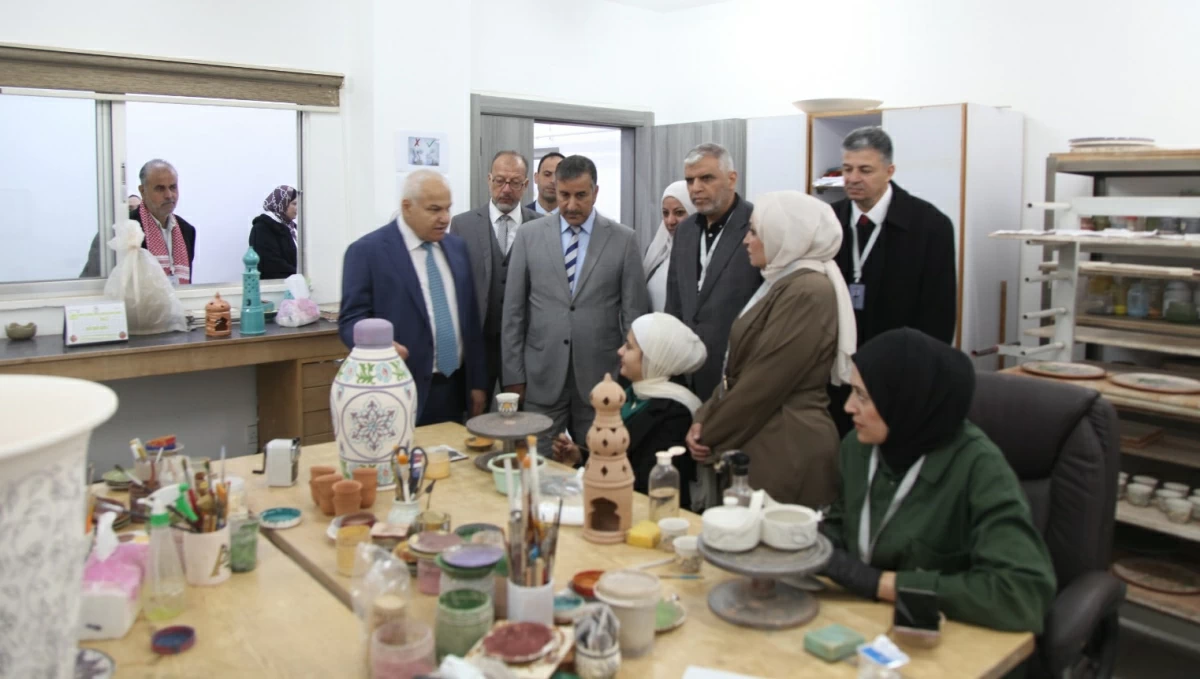
During a field visit on Monday to vocational training institutes in Salt, the northern Jordan Valley and the central Jordan Valley, Labour Minister and VTC Chairman Khaled Bakkar said that the professions targeted under the programmes would help replace non-Jordanian labourers with qualified and trained Jordanian workers.
He said that one of the VTC’s priorities is to train women in various professions to help increase female economic participation, noting that technology has been integrated into both traditional and modern vocational training programmes, according to the Jordan News Agency, Petra.
Bakkar added that, since the beginning of 2026, the corporation has started implementing two-year training programmes for technician-level specialisations and one-year programmes for assistant technicians, enabling graduates to enter the labour market with a professional licence after completion under the vocational work framework.
He also directed stakeholders at VTC to launch vocational programmes in several fields, including traditional handicraft packaging, date palm cultivation, and modern agricultural techniques.
The Salt Vocational Training Institute, established in 2003, offers a skilled worker certificate in handicrafts, along with 20 other training programmes in various fields, in addition to continuous training courses organised in cooperation with international organisations, civil society institutions and the private sector.
The minister also toured the Central Jordan Valley Vocational Training Institute, which was established in 1984, and serves the districts of South Shouneh and Deir Alla in Balqa Governorate.
The institute includes 13 training workshops tailored to the needs of the Jordan Valley.
The institute has expanded training in modern agricultural technologies in recent years, with 265 trainees enrolled in the “Ardi” project during 2024 and 2025 across eight agricultural specialisations.
The institute also seeks to expand in the agricultural field by opening up to the experiences of farmers in the Jordan Valley and building a genuine partnership with them in the training process, within programmes aligned with the Economic Modernisation Vision.
As part of the tour, Bakkar visited the garment satellite branch in Al Zimaliyah in the northern Jordan Valley in Irbid, which was established in 2018 and currently employs around 600 Jordanians.
At the end of the visit, the minister reviewed progress on the construction of the Institute for Modern Agricultural Technology, which is expected to open later this year in the Northern Jordan Valley District in Irbid.
The institute is set to serve as a key centre for technical and vocational training specialising in agriculture, and will serve the northern and central Jordan Valley, western Irbid and Taybeh district.
Bakkar also directed that specialised training programmes be introduced in various forms of irrigated agriculture.
The institute is regarded as a model of public-private partnership, aimed at making use of available resources to serve the local community and transforming its facilities into production and training platforms that open up new opportunities for young people and support sustainable development.
