






 Share Story


AMMAN — Prime Minister Jafar Hassan on Monday conducted a field inspection tour across seven sites in Maan, Karak, and the Southern Jordan Valley, as part of his regular field visits.
The tour began in Maan’s Qasbah district, where Hassan visited the Al Mohammadiyah Sub-Health Centre. He ordered comprehensive renovations and additional medical staff to enhance health services for residents, the public service broadcaster Al Mamlaka reported.
Hassan also revisited Al Mohammadiyah Mixed Secondary School and Al Mohammadiyah Boys’ Secondary School, which had undergone classroom expansions and full facility upgrades since his visit in February last year.
The prime minister then inspected the newly established Fatima Al Zahraa Coeducational Basic School in Qasbah, built under the first phase of a corporate social responsibility initiative, which aims to establish 100 schools across the kingdom over two years, improving educational environments and alleviating overcrowding
The school is set to open in the upcoming academic year and will accommodate over 800 students. It features 24 classrooms, laboratories, and a theatre. Hassan praised the private sector’s contribution to the project.
In a post on X (formerly Twitter), Hassan expressed his satisfaction with the tour, saying the feedback he received from students and teachers “reinforces the importance of these field visits in improving public services across all governorates.”
He also thanked educators for their contributions, emphasising that it is his responsibility to ensure tangible improvements at every site he visits.
In Karak, Hassan directed authorities to expedite tenders for a new emergency and ambulance centre in the northern part of the governorate. Covering 7,000 square meters and costing approximately JD7 million, the facility will provide comprehensive emergency services to local communities.
The prime minister also stressed the need to accelerate the Qatraneh afforestation project, which involves planting 50,000 trees as part of the national plan to plant one million trees annually. He called for practical solutions to address environmental challenges at the governorate’s entrance.
Hassan also praised the completion of the 18-kilometre Sarfa–Southern Jordan Valley road project in Karak, built at a cost exceeding JD10 million.
In the Southern Jordan Valley, the prime minister visited the Agricultural Industries Complex. He instructed officials to facilitate operations for companies within the complex, which contribute 20 per cent of the country’s food manufacturing output, equal to the production of all other agricultural industrial complexes in the kingdom.
Hassan emphasised the government’s support for these investments for their direct impact on the local community and the creation of hundreds of jobs.
The government has provided more than JD6.65 million in support to the complex to promote investment in the agricultural sector and develop the region’s infrastructure. The complex houses three factories and provides over 1,000 direct and indirect job opportunities.
Hassan also visited the Military Consumer Corporation Market in Ghor Safi, highlighting, alongside the corporation’s director, Major General Mohammad Al-Hadid, the importance of supporting both civilian and military consumer institutions to stabilise prices and ensure the availability of goods across the kingdom.
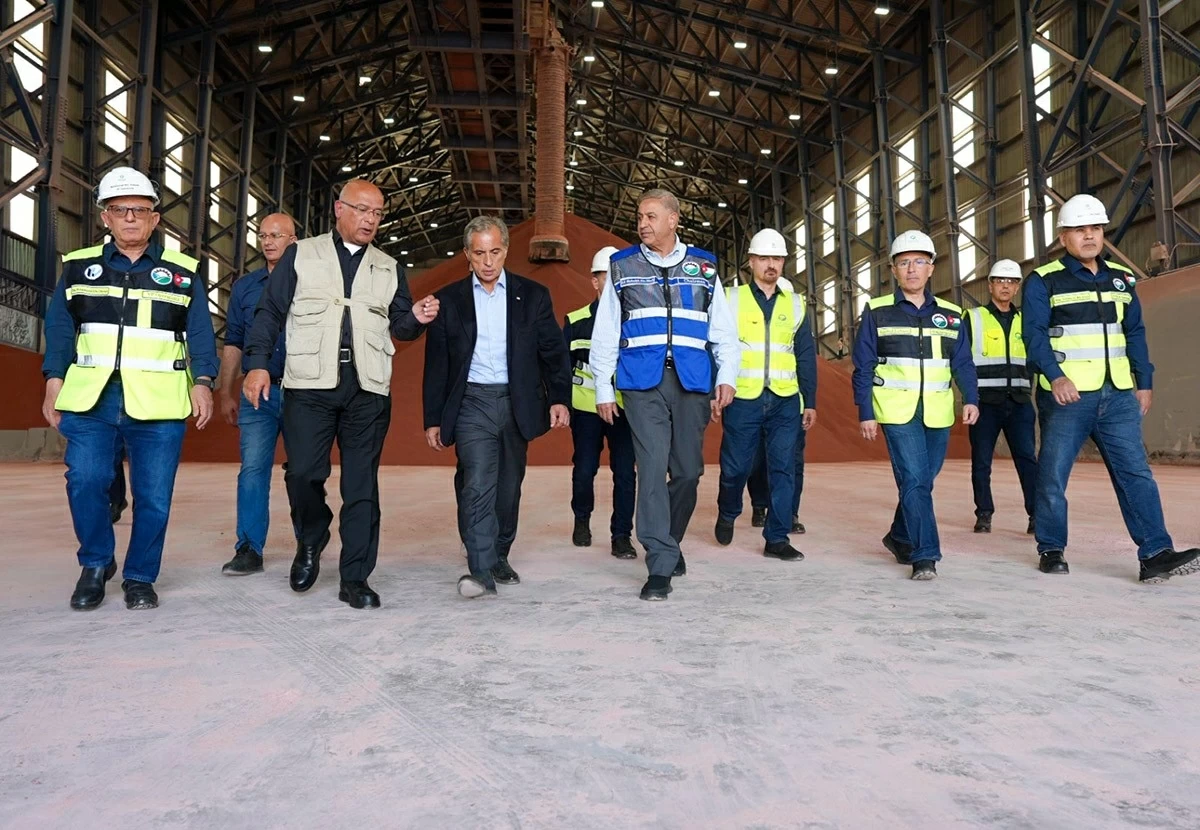
Also on Monday, Hassan visited the Arab Potash Company (APC) and the Jordan Bromine Company (JBC) in the Ghor Safi area of the Southern Ghor, where he was briefed on their new strategic expansion projects and plans.
The prime minister reviewed operations at both companies, which have achieved significant successes in increasing production and meeting growing global demand by entering new markets. Despite the current regional challenges, the companies’ supply chains continue to operate with high efficiency.
Hassan commended the companies' efforts and their active contribution to numerous corporate social responsibility (CSR) initiatives in the fields of education, health, environment, and sustainability, Al Mamlaka reported.
For his part, chairman of the board of directors of both companies, Shehadah Abu Hdaib affirmed that production, shipping, and export activities are proceeding normally.
He noted that the companies have implemented innovative logistical solutions to ensure the continuity of supply chains for clients worldwide.
Abu Hudaib pointed out that the company achieved its highest-ever production rate in the first quarter of this year. He noted that APC exports to 59 countries, with production reaching 2.85 million tonnes last year.
“The company employs 1,514 workers, all of whom are Jordanians, with 48 per cent hailing from the local community,” he added.
Regarding Jordan Bromine, Abu Hudaib said that the company is the world’s second-largest bromine producer. Last year, it exported 230,000 tonnes to over 34 countries and employed 773 Jordanians.
He also said that APC has developed six additional products, enabling access to more importers in Europe, Brazil, and new Asian markets.
JBC General Manager Samer Asfour highlighted the qualification of more than five local suppliers within Jordan, raising the local product contribution from 20 per cent to 70 per cent over the past five years. This includes increasing the use of local materials, such as packaging and chlorine.
Asfour underscored that the company has assisted local suppliers in obtaining the necessary certifications to align their products with international specifications. Furthermore, some suppliers have established two factories in Karak and the Southern Ghor, employing local labour to meet the company's requirements for transport materials.
He added that the Tetrabrom plant, the world’s largest production unit for flame retardants, is uniquely positioned due to its superior quality and low production costs. Asfour emphasised that the efficiency of local supply chains has been vital for business sustainability.
Prioritising employment for Jordanians, Asfour noted that by the end of the first quarter of 2026, local community members accounted for approximately 45 per cent of the company's total workforce.
During the visit, the prime minister was briefed on the details of two strategic expansion projects valued at approximately $2 billion.
He stressed the importance of providing training opportunities for local youth to fill the jobs created by these expansions.
The APC’s southern expansion project is valued at $1.1 billion, while the JBC expansion costs $800 million. Both projects aim to bolster production capacities and reach new international markets.
