






 Share
Share


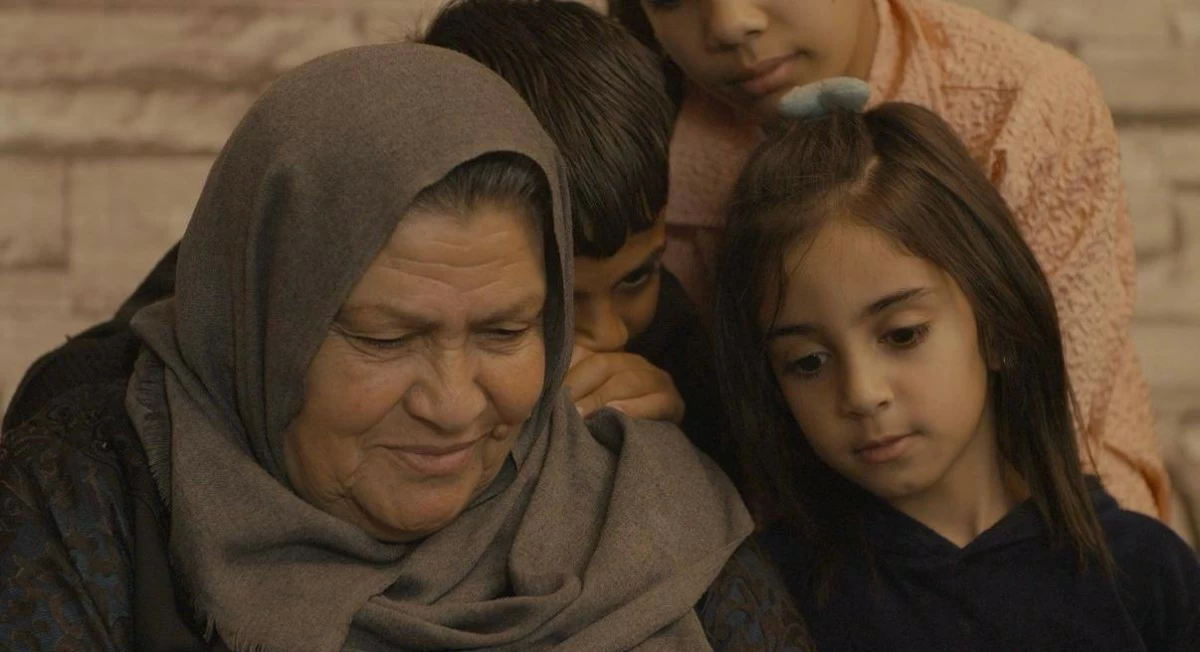
AMMAN — “For 30 years I never complained about your father! Why can’t you do the same?” says a mother to a frustrated daughter, herself a young mum separated from a husband she tries so hard to divorce from.
Bringing us to a scene of a family discussion is Simsim, a social fictional drama set in the second largest Jordanian city, Irbid. The movie follows a determined young woman who, trapped in a marriage she never wanted, agrees to find her estranged husband a new wife to win her freedom.
Performing its world premiere at the recent Amman International Film Festival, Simsimis not alone in revealing aspects of an evolving Jordanian society in which intergenerational tensions are a daily reality.
Across different stories, between fictions based on real life and unfiltered realities reproduced through documentaries, the 6th edition of the Amman International Film Festival (AIFF) showed the reality of connection, conflicts and exchange among and within generations.
If with Simsim we see on the screen a clash between very different views of love and family (traditional, conservative vs modern, open-minded) in Mother of Schools the perspective takes us in the middle of never-ending discussions about life, politics and education between youth (students) and adults (teachers, school principal and parents).
“When will the Arab societies wake up? Why did they invent the schools then?”, a student debates with his peers, angry at the teachers and principal, trying to organise, in his school, a demonstration of solidarity with Palestinians subjected to the ongoing massacre perpetrated by Israel in Gaza and the West Bank.
Taken from Mother of Schools, there are several of such scenes in a move whose representation of a diverse reality was not intentional by design, according to his director, Abdallah Essa.
The documentary, turned in the historical school for boys in Salt, showcases three distinct generations, each experiencing and perceiving the challenges and gaps in the public education system differently, leading to a clash of priorities and expectations.
For instance, teenagers’ express aspirations that often collapse under real-world pressures, which can prepare them for adult life but also leads to disillusionment. “Documentaries are new thing for me”, said Abdallah, who is used to commercial, fiction-type of filmmaking.
“To me, the only way I could make this real was to ask each group of characters what they wanted to talk about. The kids talk about their problems, so do the teachers and the principal, and to a certain extent, also the only mother present in the movie shares her frustration,” Abdallah added.
Perhaps, the fact that precisely these two movies brought the intergenerational tensions to the screen is not a coincidence. In fact, for the first time in an international festival Jordan is showcased with the peripherical lenses of Irbid and Salt, challenging the Amman-centric representation, too often the only one shown through movies in the international arena.
Adding to that, both the directors of the two movies are under their 40, and it is worth noting that the first ever long-feature narrative film about Irbid has been done by a woman, Sendos Smerat (Simsim).
Other movies, like Thank you for Banking with Us – in which two Jordanian-Palestinian sisters challenge patriarchal inheritance laws– and Tell them about us – where a group of teenage girls fled to Germany find their own creative ways to overcome hidden internal and external discrimination – follow this trend.
There is indeed clash, but always with an underlining sense of belonging to the culture and land, opposing the idea that youth seeking freedom, dreams and success need necessarily to emigrate.
On the contrary, as we majestically see in Aisha’s story – where Palestinian refugee Aisha, born in Jordan, passes the oral tradition of the food culture and identity from a generation to another –, the ambition to change, resist and innovate maintains solid roots.
For the movies’ production, crew and actors, it seems to pay off, with Simsim awarded for first-time best actress and scriptwriter, and Tell them about us winning the Jury and audience prizes.
Along the pathway set in the past years by other movies (like the Netflix productions The Alleysand Alwarabi School for Girls and Inshallah a Boy), the Jordanian film industry appears on its well-established pathway to deliver unfiltered, honest realities.
Far from glitzy red carpets (absent this year, a move in solidarity with Palestine), at the centre of a region undergoing major changes – social, politically and economically –, Jordan’s small but serious film festival is emerging strongly in the world cinematography scene.
‘We are not really after glamour,’ said AIFF Director Nada Doumani. “We don’t select films based on gender or identity. We look for sincerity, truth and conviction. That’s our only filter.”
