






 Share Story


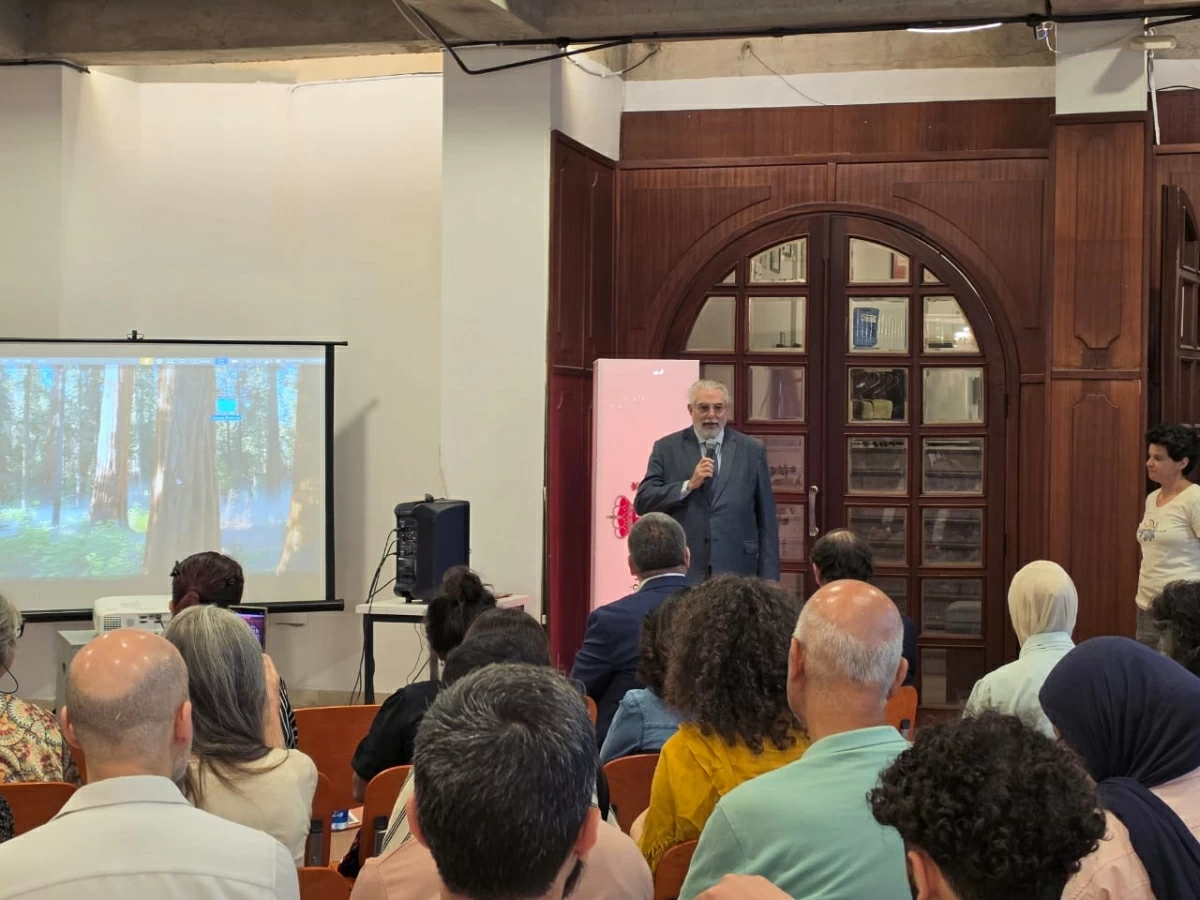
AMMAN — Visitors entering the “Menú de Gaza” exhibition at Al Balad Theatre step into two parallel narratives of war.
On one side, photographs document scenes of bombardment, destruction and devastation across Gaza.
On the other, images show something far more ordinary: plates of food, a bowl of lentils, pieces of bread, or a simple meal shared among several family members.
At the end of the exhibition stands a single image: an empty plate.
Next to it appears the message: “Using hunger as a weapon of war.”
The exhibition, organised by the Spanish embassy, is part of the 14th edition of Image Festival Amman, held at Al Balad Theatre under the theme “Behind the Scene,” and will run until June 30.
It is the result of a collaboration between Spanish conflict journalist Mikel Ayestaran and Palestinian journalist and translator Kayed Hammad, documenting daily meals prepared by Hammad’s family during the war in Gaza.
In a video message shown at the exhibition, Ayestaran recalled how his conversations with Hammad shifted after October 7, 2023.
The project began with a simple question.
“Instead of talking about stories or interviews, I started asking him every day: What have you eaten today?” he said.
As shortages worsened and food became increasingly scarce, the question turned into an unintentional record of survival.
Each day, Hammad’s wife, Amal, prepared whatever ingredients she could find. Their daughter, Dalia, photographed the meals before they were shared within the family and sent to Ayestaran, who published them online.
The images soon became a lifeline for those following the family’s situation.
For Ayestaran, those photographs became a powerful symbol of resilience and demonstrate the use of hunger as a weapon.
"Every meal became a small act of resistance," he said. "A way of saying: We are still here."
“People were waiting for these photos as signs of life,” Hammad said during a video call held as part of the exhibition.
"If we didn't upload anything, they thought something had happened to us."
What began as a personal exchange between two friends evolved into an alternative form of wartime reporting, one that documented not destruction itself, but the struggle to endure it.
“We showed the harshness of the war, but not through blood and destruction,” Hammad said.
“We showed it through what was, or wasn’t, on the table.”
During the war, the family remained in northern Gaza, displaced 17 times as fighting intensified. They lost nearly all their belongings and endured the killing of their eldest son, Omar, in an Israeli strike.
Despite this, they continued documenting what they ate each day.
Hammad described severe shortages of food, water and medicine that emerged shortly after the war began.
“Food became one of the biggest challenges for survival,” he said. “There was a shortage of everything necessary for life.”
At times, a single plate had to be divided among several people.
“Sometimes the plate was for two people and sometimes it was for seven,” he said. “Many families could not find food for days.”
For Hammad, hunger became one of the defining realities of daily life.
“There were people dying from hunger,” he said.
The project has since expanded into a book, also titled Menú de Gaza, and is being developed into a documentary and travelling exhibition.
After nearly two years in Gaza, Hammad and his family left on June 25, 2025, following coordination between Ayestaran and Spain’s Ministry of Foreign Affairs. They crossed into Jordan before continuing to Spain, where they now live in Malaga.
But leaving did not end the emotional weight of what they experienced.
“We left Gaza, but Gaza did not leave us,” Hammad said.
“When we sit down to eat, we think about those still there. We cannot finish our meals.”
Dalia said that the documentation process was a collective family effort.
“Everyone helped,” she said. “Finding ingredients, preparing food, collecting wood, it took all of us.”
“My mother would spend the whole day preparing the plate.”
Speaking to The Jordan Times on the sidelines of the exhibition, Spanish Ambassador to Jordan José Luis Pardo Cuerdo said that the situation in Gaza remains present despite other regional crises.
“The situation in Gaza has not been forgotten,” he said.
“There are already a lot of conflicts in the area, but it must not be forgotten.”
He said that the exhibition aligns with the festival’s theme, “Behind the Scene,” because it invites viewers to look beyond what is immediately visible.
“You see the photos and you see food,” Cuerdo said. “But what is beyond that? A family in Gaza, under bombardment, surviving.”
He added that the exhibition offers a different perspective from the usual imagery of war.
“We are saturated sometimes with images of destruction and suffering,” he said.
“In this exhibition you do not see blood or destruction directly. But it makes you think what is beyond what you see.”
