






 Share Story


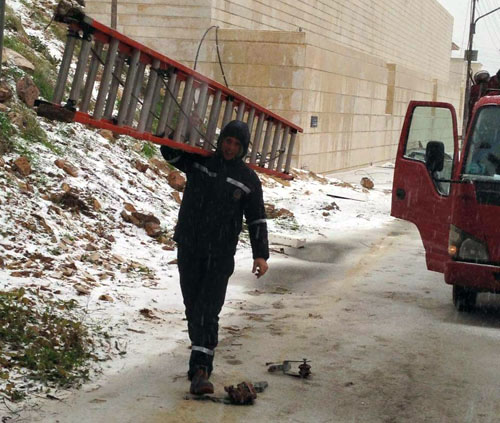
AMMAN — Ayman Tartouri, an electricity company employee, had to walk five kilometres through the snow while carrying a ladder on his back to fix an electricity pole on Um Rassas village’s main street on Saturday evening.
“We could not reach the area by car because snow was blocking the road, so my colleagues and I were forced to walk to fix the power outage,” he told The Jordan Times over the phone on Sunday.
Tartouri, who heads the Jordanian Electric Power Company
(JEPCO) branch in Madaba, was among many electricity company employees who worked in difficult weather conditions during the past six days to restore electricity in several areas of Jordan during the blizzard.
Ali Hadid, president of the Electricity Workers Union (EWU), said JEPCO received around 14,350 phone calls since the beginning of the polar front last Tuesday and 1pm on Sunday.
The majority of the phone calls were complaints of power cuts or malfunctions.
JEPCO covers Amman, Zarqa, Balqa and Madaba.
“Around 13,914 electricity malfunctions were recorded and 13,617 were fixed. Employees are currently working to fix 297 problems,” he told The Jordan Times.
The Irbid District Electricity Company (IDECO) — which supplies the governorates of Irbid, Mafraq, Jerash and Ajloun as well as some parts of Balqa — said on Monday it fixed 5,400 malfunctions during the snowstorm, the Jordan News Agency, Petra, reported.
IDECO said it received 55,000 phone calls, with more than one subscriber complaining of the same problem.
Hadid noted that call centre employees were receiving people’s complaints.
“When subscribers call us, we send them text messages with their complaint number. After we finish fixing the problem, we call the subscribers to notify them. We have made 11,000 phone calls to let people know that we fixed electricity problems,” he added.
The EWU president said all electricity companies in Jordan had an emergency plan to deal with the severe weather conditions.
“Around 1,504 employees worked during the snowstorm and many operations centres were created in Amman and other cities to deal with any emergency,” he added.
Hadid said no serious injuries were recorded among field workers.
“It takes employees three hours to finish working on each case, which covers the time we receive the complaint and the time we contact the subscribers to notify them that we fixed the problem,” he added.
Field workers interviewed by The Jordan Times said though they faced difficult weather conditions, they were determined to do their job.
Imad Harb, an electricity field worker, said he dealt with many cases during the snowstorm.
“In one of the cases, three electricity poles fell at 5am and my four colleagues and I fixed the problem quickly. I spent one day out of my home without sleeping,” he added.
Harb noted that his company provided cars equipped to navigate roads through snow to make their job easier.
Tartouri said he fell on the ground twice, hurting his hands.
“I am sure that my hands need to be checked but I did not want to go to hospital because they would force me to stay there and not go to work. I wanted to join my colleagues to make sure the job is done and will check on my health later.”
