






 Share Story


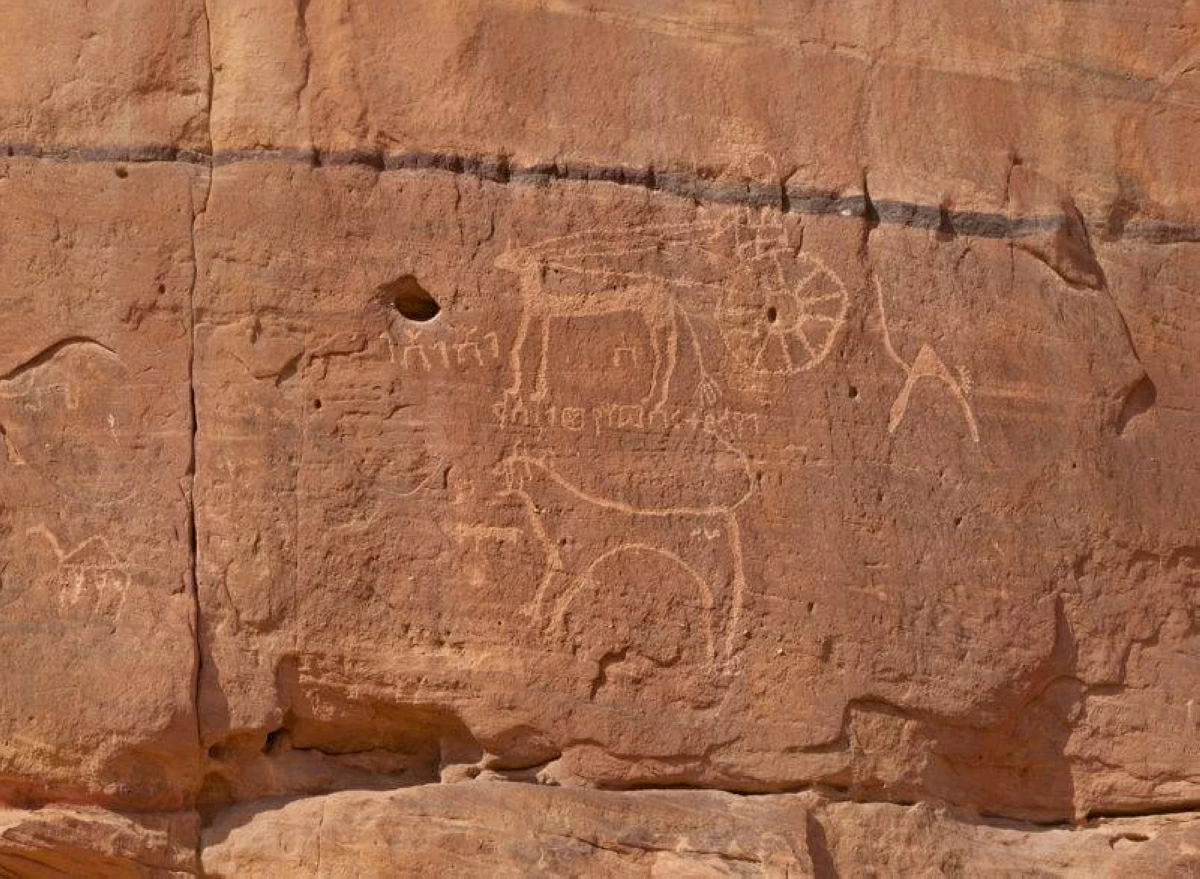
AMMAN — Desert regions of Arabia have been for thousands of years a surface for drawings and engravings. On these engravings, anthropomorphic and zoomorphic pictures can be seen.
The corpus of rock art of Arabia has received little formal study due to the remoteness of many of the regions where rock art is concentrated, but another factor may well be that it is extremely difficult to date a large proportion of the engravings, noted Australian archaeology professor Alison Betts.
"Reliable dating of rock art is a universal problem and Arabia is no exception. While most rock art is found on exposed outcrops without clearly associated archaeological deposits, some prehistoric carvings on loose stones have been found in stratified contexts," said Betts.
For the later periods, a considerable amount of the known rock art of Arabia can be broadly dated on the basis of direct association with pre-Islamic inscriptions through reference to the image in the text accompanying it.
These texts, in languages related to Arabic, date broadly from the mid-first millennium BC to the period of Roman/Byzantine influence in the Middle East. They include scripts, dialects and languages such as Nabataean, Safaitic, Hismaic and various forms of Thamudic.
The Safaitic, Hismaic and Thamudic texts are the graffiti of the nomads of the Syro-Arabian desert.
It is difficult to date the texts but the Safaitic inscriptions are generally thought to belong to the period from the 1st century BC to the 4th century AD, and the different types of Thamudic to approximately the 7th century BC to the 3rd century AD.
To these may be added the South Arabian texts which, in the south of the Arabian Peninsula, are also occasionally directly associated with carved images.
The texts provide only an approximate date range. They do not provide absolute dates although they may contain such formulae as "the year the king died". In practice, although it might be possible to speculate as to the meaning of such formulae, they are not a reliable means of absolute dating.
The inscriptions can also only be used for general dating purposes where the text gives specific reference to the content of the image, as mere juxtaposition of image and text does not ensure that the two are contemporary.
"For the Islamic period, images directly relating to inscriptions are rare, although the presence of absolute dates in texts occurs occasionally. Dating of rock art is, in most cases, a generally inaccurate process.”
“In the case of stratified rock engravings, dating can only be broadly based on a range of C14 dates or relative dating of associated artefacts," Betts said.
With the exception of some late examples, most inscriptions cannot be dated more closely than within several centuries, the archaeologist continued.
She added that on a more general level, images may occasionally be dated tentatively on the basis of stylistic parallels with other images of known date but such comparisons are largely subjective and may well be inaccurate.
"Classification by style is also used where no absolute date is known; dating for such styles is based on criteria such as content, method of manufacture and super- imposition.”
“To link styles with hypothetical cultural entities on the basis of modern art-historical perspective can only provide very tenuous results and must be viewed with caution. In some cases, the appearance of depictions of certain animals can help to provide a terminus post quem for rock art but again this is problematic," Betts said.
While the earliest rock art probably precedes domestication, it is rarely possible to distinguish domestic sheep and goat from wild ungulates, except when the fat-tailed sheep is clearly depicted. Domesticated donkeys and cattle cannot be easily distinguished from their wild counterparts.
The horse probably came to be used in northern and eastern Arabia around the second half of the first millennium BC. Since it is an introduced species, its appearance in rock art should date from this time or later.
Wild camels were also present in the southern parts of the Middle East, although their precise distribution is not known. They may have been domesticated as early as the third millennium BC in the southern part of the peninsula.
"The camel is a common subject in art associated with pre-Islamic inscriptions but it can only be used broadly as a means of relative dating for rock art, in that where the animal is shown harnessed or with a rider, the depiction must date from at least the historic periods,” the archaeologist said.
“Some rock carvings appear to show the hunting of wild camels but other similar examples may show raiding of herded animals. Rare depictions of exotic animals such as the two-humped Bactrian camel must also, at the least, post-date the prehistoric era," Betts added.
