






 Share Story


AMMAN — The Pre-Pottery Neolithic A (PPNA) Period in the Levant provides the earliest confirmed evidence for plant cultivation anywhere in the world, marking a “significant” revolution in the human management of plants towards fully fledged agricultural food production.
The PPNA took place between 9,600–8,500 BC.
For the time being, the majority of PPNA sites have been documented in the Jordan Valley, the Wadi Araba and farther north along the Upper Mesopotamia.
One of Jordanian PPNA sites is Qa Shubayqa, located in the north-eastern part of the country in the Black Desert.
"Shubayqa 6 is situated on the northern edge of the Qa’ Shubayqa, around 130km north- east of the Jordanian capital, Amman. The site is one of several late Pleistocene and early Holocene settlements located in this area, which have been under investigation since 2012,” said Patric Pedersen from the University of Copenhagen.
The Late Epipalaeolithic Natufian sites Shubayqa 1 and Shubayqa 3 are situated 0.7km west and 3.1km south-east from Shubayqa 6 respectively, he added.
The concentration of settlements in this area is probably due to the existence of a substantial area of permanent wetland that occupied the present basin during the late Pleistocene and early Holocene, providing a wide and rich range of resources.
Shubayqa 6 rises two to three metres above the surrounding area, and consists entirely of anthropogenic deposits.
Several Byzantine, early Islamic and later structures, as well as a Bronze Age occupation phase, overlie the Neolithic settlement, Pedersen noted, adding that chipped stone and ground stone artefacts cover the entire 3000m of the mound and the surrounding area.
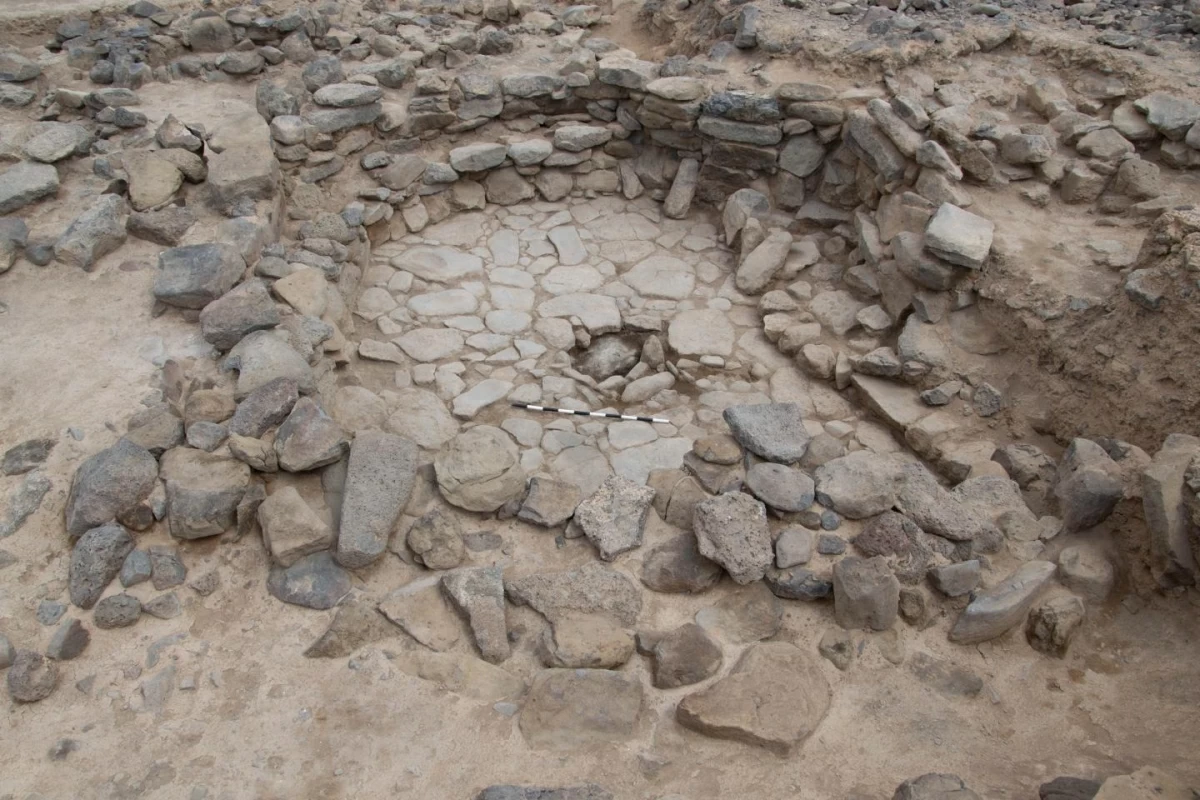
"Shubayqa 6 was discovered during a pedestrian survey in October 2012. To date, excavations have revealed a complex series of circular or sub-circular buildings, which reflect the multiple phases of occupation and reuse of the settlement," Pedersen said.
The structures uncovered so far range from small buildings, less than two metres in length, to buildings with a diameter of four metres.
Two larger structures, measuring six and five metres in maximum length have also been uncovered. Although most structures at the site are as yet unexcavated down to floor level, those that have been demonstrate well-made floors and fireplaces, Pedersen underlined.
Art objects are represented by an anthropomorphic chalk figurine and a T-shaped bone plaque with incisions.
“Organic preservation at Shubayqa 6 is excellent. In addition to a large faunal assemblage, intensive flotation of sediment samples has produced a substantial assemblage of macro- botanical plant remains, which is currently being analysed.”
“Shubayqa 6 is the first substantial PPNA settlement identified in the Black Desert. It demonstrates that settlement in this semi-arid to arid zone was more intensive than previously thought,” Pedersen noted.
The team plans to continue with its work at Shubayqa 6 to highlight the transition from hunting and gathering to food production in the Levant.
