






 Share
Share


AMMAN — The Badia Epigraphic Survey (BES) Project, launched in 2015, has played a “crucial” role in re-documenting Safaitic inscriptions.
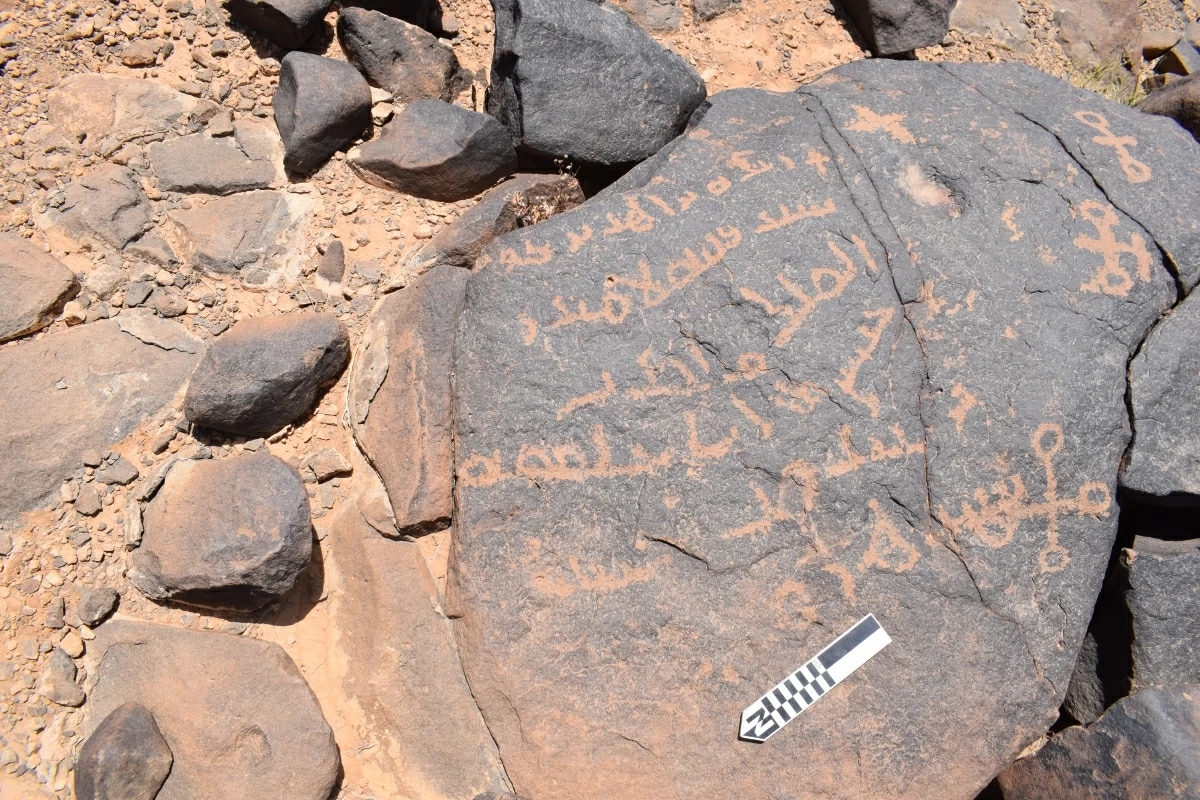
"In 2024, BES team and I documented a Christian Paleo-Arabic inscription engraved in stone. The text is explicitly Christian in content, invoking God and reflecting a Christian religious milieu, while being written in an early form of Arabic using a Paleo-Arabic script," said Ali Manaser from Hashemite University.
Manaser added that this inscription is significant because it provides direct evidence for the use of Arabic by Christian communities before Islam and contributes to the understanding of the linguistic and cultural environment of Late Antique Arabia and the Levant.
This inscription constitutes the first securely dated Paleo-Arabic inscription explicitly referring to Al Mundhir III and one of the very few “insider” Arabic sources documenting Ghassanid authority.
Its probable date of 575 AD situates it at a critical moment in Al Mundhir’s reign, shortly after his reconciliation with the Byzantine authorities, and reflects the growing political autonomy of Arab Christian rulers in the late sixth century.
The use of the title mlk (“king”) provides valuable evidence for indigenous Arabic conceptions of rulership, distinct from Roman imperial titulature.
"The text represents a major contribution to the corpus of early Arabic writing, bridging the gap between Nabataean-Arabic and later classical Arabic. It sheds light on early developments in Arabic grammar and orthography, including numeral usage, name formation, and the orthographic rendering of royal names," Manaser said.
In particular, the spelling ʾmndr offers new insight into the pronunciation of the name Al Mundhir and its Greek transcriptions (Alamoundaros), with broader implications for the vocalisation and morphology of early Arabic onomastics.
The explicitly Christian character of the inscription—indicated by the engraved cross and the possible reference to almsgiving—demonstrates that Arabic functioned as a written language of Christian devotion and administration prior to Islam, the scholar said Manaser.
The text strengthens the evidence for close links between the Jafnid rulers and Christian institutions, including charitable practices and monastic networks in the province of Arabia, he explained.
Manaser noted that the discovery reinforces the importance of the Jordanian Ḥarrah as a key landscape for understanding the emergence of written Arabic and Arab political authority in Late Antiquity.
"It highlights the value of systematic epigraphic survey in Jordan and its potential to reshape prevailing narratives concerning the linguistic, religious, and political history of the Arab populations of the 6th century AD.”
The origin of imperial titles
AlMundhir (AlMuḏir) was a Ghassanid Arab king, ruling as a Byzantine foederatus in the 6th AD.
"He was a prominent Christian Arab leader who played a key political and military role on the eastern frontier of the Byzantine Empire. The inscription mentions imperial titles associated with Byzantine authority, reflecting his status as a client king operating under imperial auspices," Manaser highlighted.
These titles underline the close relationship between the Ghassanid leadership and the Byzantine imperial system, and they provide important historical context for understanding Arab–Byzantine relations in Late Antiquity.
Regarding the BES, it is one of the most significant international initiatives dedicated to the documentation of ancient North Arabian inscriptions (ANA) and related epigraphic traditions in Jordan, Saudi Arabia, and southern Syria, Manaser said, adding that data was collected through systematic field survey and high-resolution digital recording.
The BES collected nearly half a million images, documenting tens of thousands of inscriptions.
"Among the most important outcomes of the survey is the discovery of numerous rare and previously undocumented inscriptions in the Jordanian Badia, including Palmyrene, Greek, pre-Arabic, and a vast corpus of North Arabian inscriptions. All documented materials are systematically catalogued in specialized databases and made freely accessible to researchers worldwide," Manaser pointed out.
The BES Project significantly expands our scientific and historical knowledge of pre-Islamic Arabia, contributes to the study of the development of the Arabic language and script, and deepens our understanding of Jordan’s cultural heritage and the broader civilisational legacy of the region, he underscored.
