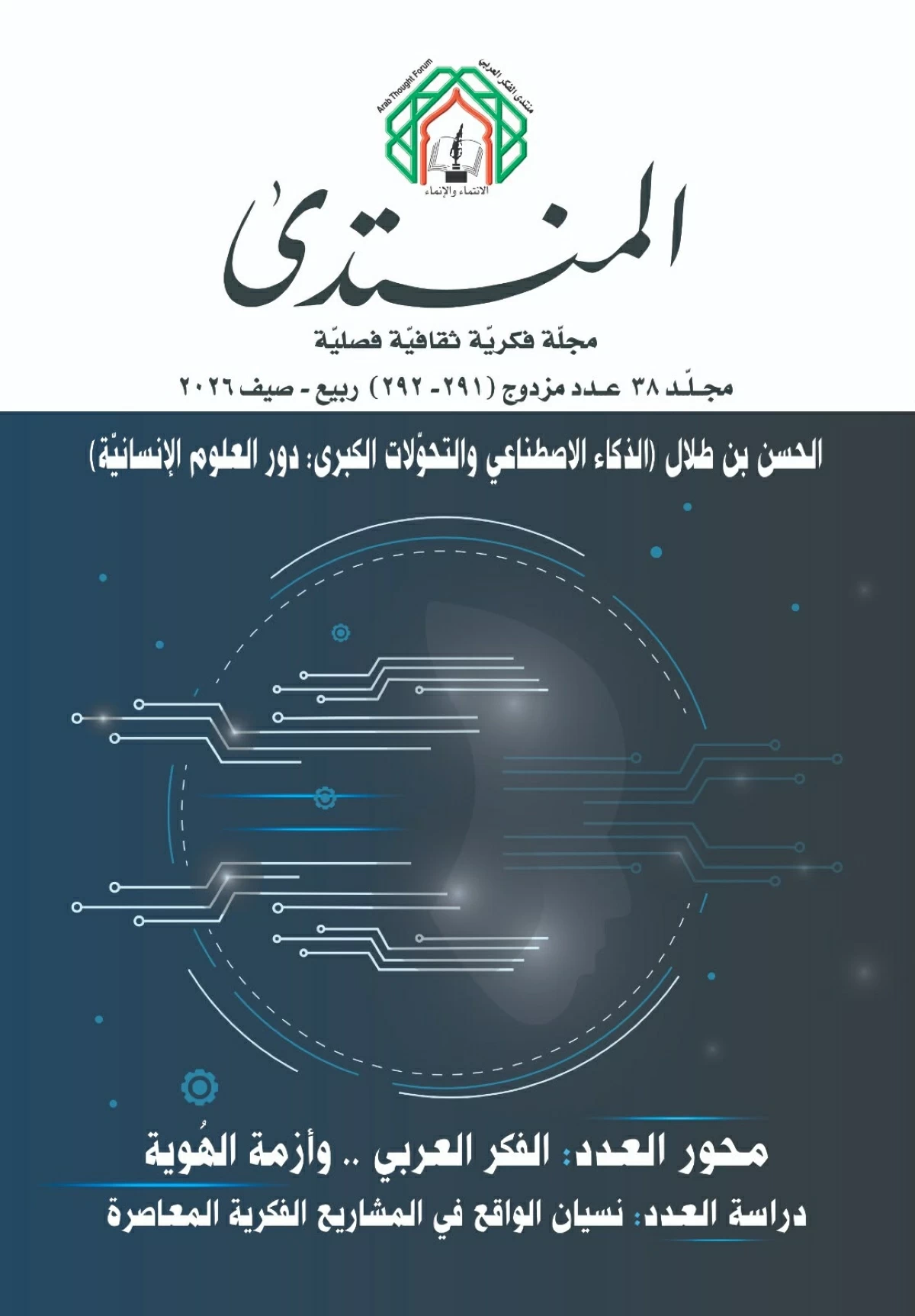


Arab Thought Forum publishes double issue of Al Muntada

The issue opens with HRH Prince El Hassan bin Talal’s keynote address at the 51st Session of the Royal Academy of Morocco, titled “Artificial Intelligence and Major Transformations: The Role of the Humanities.” (Photo courtesy of Arab Thought Forum)

No Image

AMMAN — The Arab Thought Forum has recently published the double issue (291–292) of its quarterly intellectual and cultural journal, Al Muntada.

The issue opens with a keynote address delivered by HRH Prince El Hassan Bin Talal, Chairman and Patron of the Forum, at the 51st Session of the Royal Academy of Morocco, titled “Artificial Intelligence and Major Transformations: The Role of the Humanities,” according to a statement by the forum.

In his address, Prince El Hassan said humanity has entered a new historical phase extending beyond the Fourth Industrial Revolution, with AI emerging as a defining force reshaping knowledge, production systems, and daily life, what he described as the Fifth Industrial Revolution.

He stressed that this transformation should not be viewed as a purely technical shift, but as a profound change in human cognition itself, redefining the relationship between humanity, knowledge, and machines, calling for critical awareness and a commitment to adapting to change without compromising ethical and human values.

Prince El Hassan also noted that, despite its complexity, AI remains a neutral tool whose impact depends on human use.

The real challenge, he said, lies not in the technology itself but in ensuring its ethical application in ways that promote justice, protect privacy, preserve human dignity, and safeguard cultural diversity.

He also highlighted the need to address emerging challenges linked to AI development, particularly algorithmic bias and intellectual property rights.

He called for international ethical and legislative frameworks, and for stronger engagement by the humanities and social sciences in shaping the future of artificial intelligence to ensure balance between technological progress and cultural and civilizational considerations.

Prince El Hassan emphasised the importance of moving beyond theoretical debate toward practical action, including support for scientific research and the development of linguistic and knowledge systems that reflect cultural diversity.

He also called for enhanced international cooperation to ensure AI serves as a tool for empowerment rather than exclusion, and as a partner to human intelligence rather than a replacement for it.

In the issue’s editorial, El Sadig El Faqih, former Secretary-General of the Arab Thought Forum, addressed Arab thought and the identity crisis, describing identity as one of the most complex and pressing challenges facing contemporary Arab intellectual discourse.

He noted that many Arab societies still lack a clear and renewed vision of their unity and enduring civilisational identity.

El Faqih stressed that drawing on Arab civilisational heritage and reviving original, innovative ideas are essential to overcoming the intellectual and ideological fragmentation that hinders progress in the modern world.

He added that science and technology are among the most effective tools for strengthening civilisational identity.

"Historically, they have been a source of cultural depth and pride for the Arab world, and today they can help revive intellectual heritage and reapply it in contemporary contexts that address current challenges, reinforcing a sense of belonging and identity," he added.

The issue’s special section, “Arab Thought and the Identity Crisis,” brings together a group of Arab intellectuals and researchers who examine the challenges facing Arab identity from philosophical, cultural, social, and political perspectives.

.col-lg-12.second .opinion-widget{border-top:1px solid #D0D0D0;} #widget_1623 .opinions-title {font-size:32px;} #widget_1623 .opinions-title a{font-size:32px;} .first-author{ background-color:#ecedef; } .first-opinion-author-name{ background-color:white; width:max-content; padding:5px; }
.epaper-separator{ height: 1px; width: 100%; background-color: #D0D0D0; margin: 15px 0; }

Today’s Paper

.related-articles .article-widget-sm .article-title{font-size:16px;-webkit-line-clamp:3;} .related-articles .layout-ratio{padding-bottom:55%;}
.alert-success { color :#A3656F ; } .alert-danger { color : red ; } .footer { font-family:Myriad Pro,Arial; } .newspaper-footer{ visibility:hidden; } .socialFixOuter { position: fixed; top: 50%; margin-top: 40px; right: 0; transition: .2s; z-index: 20; height: 217px; width: 40px; } .socialFix { height: 30px; width: 30px; display: block; position: relative; cursor: pointer; background-size: 18px 18px; transition: .2s; background-position: center; background-repeat: no-repeat; border-radius: 2px; margin-top: 1px; } .socialFix:hover { width: 40px; margin-left: -10px; } .app-badge-img { height: 36px; width: auto; } @media (max-width: 768px) { .app-badge-img { height: 32px; } .app-badges { justify-content: center !important; } }
document.addEventListener("DOMContentLoaded", function () { const socialFix = document.querySelector(".socialFixOuter"); if (!socialFix) return; let firstInteraction = false; let hideTimeout = null; function checkMobileScreen() { if (window.innerWidth < 768) { socialFix.style.display = "none"; } else { socialFix.style.display = "block"; } } checkMobileScreen(); window.addEventListener("resize", checkMobileScreen); function handleFirstInteraction() { if (firstInteraction) return; if (window.innerWidth < 768) return; firstInteraction = true; socialFix.style.right = "-25px"; } socialFix.addEventListener("mouseenter", function () { if (window.innerWidth < 768) return; if (hideTimeout) clearTimeout(hideTimeout); socialFix.style.right = "0"; }); socialFix.addEventListener("mouseleave", function () { if (window.innerWidth < 768) return; if (hideTimeout) clearTimeout(hideTimeout); hideTimeout = setTimeout(() => { socialFix.style.right = "-25px"; }, 500); }); ["click", "touchstart"].forEach((evt) => { socialFix.addEventListener(evt, handleFirstInteraction); }); }); function validateEmail(email) { if (email.length > 255) return false; const emailRegex = /^[a-zA-Z0-9._%+-]+@[a-zA-Z0-9.-]+\.[a-zA-Z]{2,}$/; if (!emailRegex.test(email)) return false; if (email.includes('..') || email.startsWith('.') || email.endsWith('.')) return false; return true; } function sanitizeInput(input) { input = input.replace(/<[^>]*>/g, ''); input = input.replace(/javascript:/gi, ''); input = input.replace(/on\w+\s*=/gi, ''); input = input.replace(/[<>"'&(){}[\]]/g, ''); return input.trim(); } document.addEventListener('DOMContentLoaded', function () { function showModal(message, type) { const messageContainer = document.getElementById("messageContainerFooter"); messageContainer.textContent = message; messageContainer.className = `alert alert-${type} mt-3`; messageContainer.classList.remove("d-none"); setTimeout(() => { messageContainer.classList.add("d-none"); }, 5000); } document.getElementById("emailFormFooter").addEventListener("submit", function(event) { event.preventDefault(); const emailInput = document.getElementById("emailFooter"); const email = sanitizeInput(emailInput.value.trim()); if (!validateEmail(email)) { showModal('Invalid email format', 'danger'); return; } const formData = new FormData(); formData.append('email', email); fetch('/subscribeNewsletter', { method: "POST", body: formData, headers: { "Accept": "application/json", "X-Requested-With": "XMLHttpRequest" } }) .then(response => { if (!response.ok) { showModal("Error submitting email. Try again.", 'danger'); } return response.json(); }) .then(data => { showModal(data.message, 'success'); }) .catch(error => { showModal("Error submitting email. Try again.", 'danger'); }); }); });