






 Share Story


AMMAN — The Ammonite citadel was uncovered at the western end of the acropolis of Tell Umairi and its walls were much thicker than normal domestic dwellings, ca.
1.10-1.75 m, and it has been suggested that the structure was used for administrative and defensive purposes.
"It was here that the team found a seal impression of a major governmental official, Milkom'ur, who served an Ammonite king named Ba'alyasha', the Baalis of Jeremiah," said Professor Larry Herr from Canadian University College.
Herr added that to the north of the citadel was a four-room house, a typical house plan of the Iron Age throughout Palestine.
Although the building had similar dimensions to other large four-room houses, the thickness of the walls (ca. 1.0-1.4 m) suggests that it was intended to be more than a domestic dwelling, perhaps an annex to the southern administrative complex.
The original floors have not yet been reached.
"The third building to the north had at least seven narrow rooms connected by doorways. In one room was a stairway with very narrow steps leading down to the basement level, while another had at least two pillars holding up the roof," Herr noted.
The professor added that the finds from the floor of this structure were generally domestic in nature.
Because two seal impressions on jars, bearing the name Beerammon, were found here, the team have dubbed it the "House of Beerammon."
Its large, rambling size is unique in the archaeology of Persian period.
Although the walls of the gate were only ca. 1.50 m thick and founded just a few centimetres below surface level, other indications suggest that security was not a major problem at this time and defences were universally weak.
Fragmentary and ephemeral terrace walls were found in most other fields on the site.
"At Jawa, the late Iron II period witnessed at least three phases of occupation, each with surfaces containing domestic objects. One yielded a human figurine head wearing an Ammonite royal crown. In the last phase, the inhabitants used quoin-and-pier wall construction, typical of Phoenician architecture, especially in the Persian period.
The site was protected by two casemate walls, one on top and inside the other. On the surfaces beneath the last destruction of the site were 13 javelin points, suggesting a military destruction.
"Because there does not seem to be early Persian pottery at Jawa, it may have been destroyed by the Babylonian campaign against the Ammonites in 582 BC mentioned by a historian Josephus," said Herr, adding that at el Dreijat, the first fortress was constructed of extremely large stones and thick walls (ca. 2.5 m thick).
However, later occupants completely destroyed all floors from this period. Due to its plan and location on the highest hill in the region, it was strategically located for military and communication purposes, the professor underlined.
Rujm Selim, a large agricultural complex north of 'Umeiri, was also built for the first time in the late Iron II period. It was built with slightly smaller stones and narrower walls than el Dreijat. But because the walls were still quite formidable, it may be termed a "fortified farmstead".
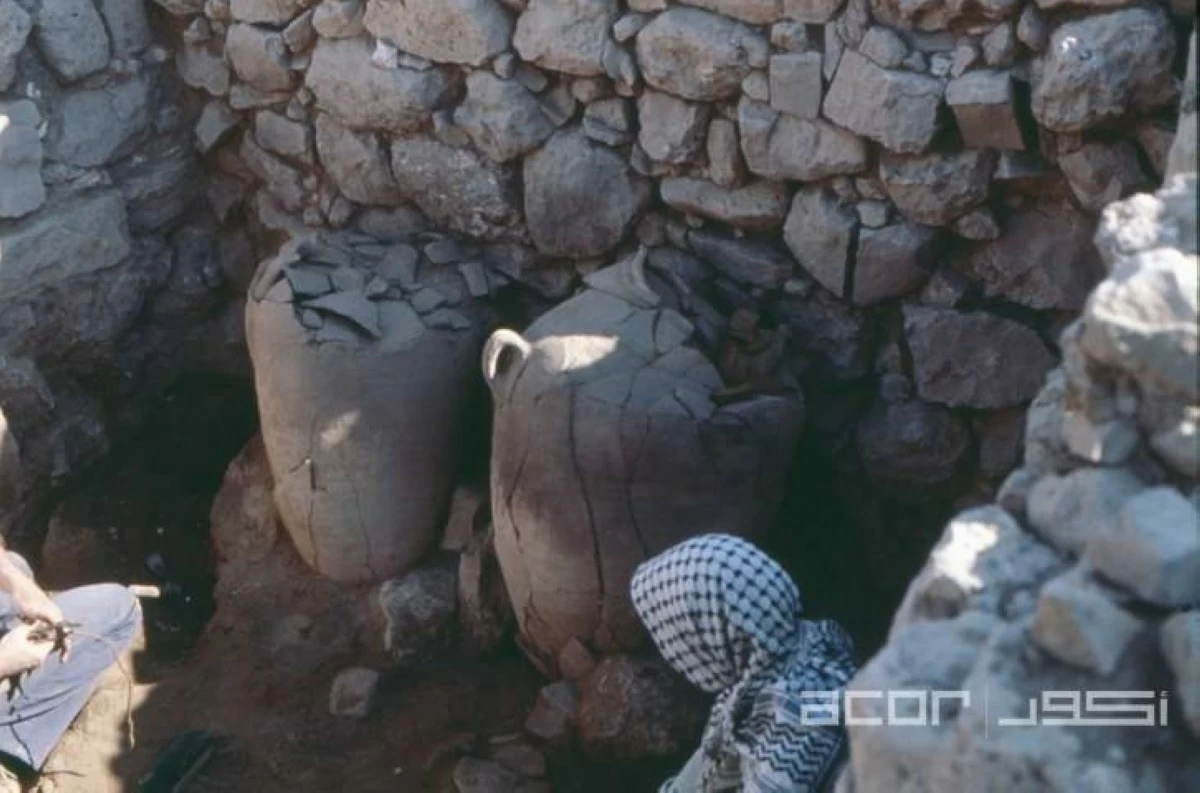
"Its associated finds, such as a winepress, a storage cave, and the presence of scores of store jar fragments, as well as its location on the side of a hill overlooking croplands suggest its agricultural function," Herr underlined.
He noted that about50 similar complexes have been found by the survey throughout the region. All tend to be located on hillsides overlooking croplands; many include winepresses, storage facilities, and cisterns; and most were constructed of large limestone and chert boulders which were easier to quarry than large numbers of small stones.
Other late Iron II finds made by the survey include field watchtowers used to guard crops close to harvest time.
"The abatement process in the early Persian period seems to have been gradual. Jawa was not rebuilt after it was destroyed at the end of Iron II, while at Umeiri, the last architectural phase of the Ammonite citadel area was inferior to the first.”
The last surfaces were irregular and poorly made, while new walls were weak and poorly constructed. Although the Iron II phases showed evidence of town planning, early Persian phases did not," Herr concluded.
